Physical Address
304 North Cardinal St.
Dorchester Center, MA 02124
Physical Address
304 North Cardinal St.
Dorchester Center, MA 02124


Salat al-Subh, is the first of the five obligatory daily prayers in Islam. It is performed at dawn, when darkness begins to give way to daylight, and its prescribed time ends at sunrise.
Prayer is one of the greatest acts of worship in Islam. Allah has commanded Muslims to establish the five daily prayers and to observe them at their appointed times.
Allah says:
إِنَّ الصَّلَاةَ كَانَتْ عَلَى الْمُؤْمِنِينَ كِتَابًا مَوْقُوتًا
Meaning: Indeed, prayer has been prescribed upon the believers at specified times.
Reference: The Noble Qur’an, Sūrat al-Nisā’ 4:103.
The five obligatory prayers are Fajr, Ẓuhr, ‘Aṣr, Maghrib and ‘Ishā’. Every adult Muslim who is mentally capable and responsible under Islamic law must observe these prayers, subject to the rulings and concessions established in the Sharī‘ah.
Fajr consists of two obligatory rak‘ahs, preceded by two highly recommended Sunnah rak‘ahs.
It is important to distinguish between them:
Two Sunnah rak‘ahs: These are voluntary prayers performed before the obligatory Fajr prayer.
Two obligatory rak‘ahs: These are the two rak‘ahs of Fajr that Allah has commanded Muslims to perform.
The Prophet Muhammad (peace and blessings be upon him) consistently observed the two Sunnah rak‘ahs before Fajr and emphasised their great virtue.
‘A’ishah (may Allah be pleased with her) reported that the Messenger of Allah ﷺ said:
“The two rak‘ahs at dawn are better than this world and all that it contains.”
Reference: Ṣaḥīḥ Muslim, 725a.
This guide explains how to prepare for Fajr, perform wuḍū’, pray the two Sunnah rak‘ahs, perform the two obligatory rak‘ahs correctly, and observe authentic remembrances after the prayer.
The objective is to help Muslims worship Allah according to the Qur’an and the authentic Sunnah, while respecting legitimate differences among qualified Sunni scholars.
Understanding the time of Fajr is essential because every obligatory prayer must be performed within its prescribed time.
Fajr begins with the appearance of the true dawn (al-fajr al-ṣādiq).
True dawn is the horizontal spreading of light across the eastern horizon. It becomes increasingly clear until sunrise.
It is different from the false dawn, which appears as a vertical column of light before disappearing and does not mark the beginning of Fajr.
The Prophet ﷺ explained the distinction between the two kinds of dawn in narrations concerning the prayer times.
The time of Fajr begins with true dawn and continues until the sun begins to rise.
The Prophet ﷺ said:
“The time of the morning prayer is from the appearance of dawn, as long as the sun has not risen.”
Reference: Sahih Muslim, 612.
The prescribed time of Fajr ends when the sun begins to rise.
Therefore, Muslims should organise their mornings to complete Fajr before sunrise.
Allah says:
وَقُرْآنَ الْفَجْرِ ۖ إِنَّ قُرْآنَ الْفَجْرِ كَانَ مَشْهُودًا
Meaning: And the recitation at dawn. Indeed, the recitation at dawn is witnessed.
Reference: The Noble Qur’an, Surat al-Isra’ 17:78.
This verse highlights the special significance of the dawn prayer.
Practical advice
To protect your Fajr prayer:
Check a reliable local prayer timetable.
Set an alarm early enough to perform wudu’ and pray without rushing.
Avoid staying awake unnecessarily late.
If possible, attend the congregational prayer at your local mosque.
Do not deliberately delay Fajr until sunrise.
Prayer times differ according to location, date and calculation method. Muslims should therefore consult a reliable timetable for their area.
Before beginning prayer, a Muslim should ensure that the necessary conditions for valid prayer are fulfilled.
2.1. Islam and religious responsibility
Prayer is an act of worship prescribed for Muslims.
The obligation of prayer applies to adult Muslims who possess the mental capacity required for religious responsibility, subject to the established Islamic rulings.
2.2. The prescribed time
The obligatory Fajr prayer must be performed within its prescribed time unless a valid excuse, such as genuine sleep or forgetfulness, prevents this.
2.3. Ritual purity
A Muslim must be in a state of ritual purity before praying.
If wudu’ has been invalidated, it must be renewed.
If a person is in a state of major ritual impurity requiring ghusl, wudu’ alone is insufficient.
Allah says:
وَإِنْ كُنْتُمْ جُنُبًا فَاطَّهَّرُوا
Meaning: And if you are in a state of major ritual impurity, then purify yourselves.
Reference: The Noble Qur’an, Sūrat al-Mā’idah 5:6.
2.4. Cleanliness of the body, clothing and prayer place
The body, clothing and place of prayer must be free from relevant impurities.
Islam encourages cleanliness, and the removal of ritual or physical impurity must follow the applicable Islamic rulings.
2.5. Covering the ‘awrah
A person must cover the parts of the body that Islamic law requires to be covered during prayer.
The details differ between men and women. Clothing should also be sufficiently clean and suitable for prayer.
2.6. Facing the Qiblah
Muslims face the direction of the Ka‘bah in Makkah when praying, provided they are able to do so.
Allah says:
فَوَلِّ وَجْهَكَ شَطْرَ الْمَسْجِدِ الْحَرَامِ
Meaning: So turn your face towards al-Masjid al-Ḥarām.
Reference: The Noble Qur’an, Sūrat al-Baqarah 2:144.
Those who genuinely cannot determine the direction should make a reasonable effort to establish it.
2.7. Intention (niyyah)
The intention is the determination in the heart to perform a particular act of worship.
For Fajr, the worshipper intends in the heart to perform the two obligatory rak‘ahs of Fajr for Allah.
A special verbal formula is not required.
A person does not need to say, “I intend to pray two rak‘ahs of obligatory Fajr for Allah,” before beginning.
The intention is an act of the heart, not a prescribed sentence that must be spoken aloud.
Wudu’ is the prescribed minor ritual purification required before prayer when a person does not already possess valid wudu’.
Allah explains its principal actions in the Qur’an.
He says:
يَا أَيُّهَا الَّذِينَ آمَنُوا إِذَا قُمْتُمْ إِلَى الصَّلَاةِ فَاغْسِلُوا وُجُوهَكُمْ وَأَيْدِيَكُمْ إِلَى الْمَرَافِقِ وَامْسَحُوا بِرُءُوسِكُمْ وَأَرْجُلَكُمْ إِلَى الْكَعْبَيْنِ
Meaning: O you who believe, when you rise to perform prayer, wash your faces and your hands up to the elbows, wipe your heads, and wash your feet up to the ankles.
Reference: The Noble Qur’an, Sūrat al-Mā’idah 5:6.
Step 1: Make the intention
Intend in your heart to perform wudu’ for purification.
You do not need to pronounce a special intention.
Step 2: Say Bismillāh
Say:
بِسْمِ اللَّهِ
Transliteration: Bismillāh.
Meaning: In the name of Allah.
Scholars have discussed the strength and implications of the reports concerning saying Bismillah before wudu’. Some regard it as obligatory, while others regard it as recommended.
The report commonly cited on this matter is found in Sunan Abi Dawud, 101, and Jāmi‘ al-Tirmidhī, 25. Its authentication has been discussed by hadith scholars.
Saying Bismillah is good practice, but the strength of the evidence should not be overstated.
Step 3: Wash the hands
Wash both hands up to the wrists.
It is recommended to wash them three times.
Step 4: Rinse the mouth
Take water into the mouth, move it around and spit it out.
Repeat up to three times.
Step 5: Clean the nose
Draw water gently into the nose and expel it.
Repeat up to three times.
A person who is fasting should avoid excessive inhalation of water.
Step 6: Wash the face
Wash the entire face, from the normal hairline to the chin and from one side of the face to the other.
Ensure that the water reaches the required area.
Washing the face once is sufficient, although washing it three times is established in the Sunnah.
Step 7: Wash the arms
Wash the right arm and then the left arm, including the elbows.
Wash each arm once, twice or three times.
The elbows must be included.
Step 8: Wipe the head and ears
Wet the hands and wipe the head.
The established method described in authentic reports involves wiping over the head with wet hands.
The ears are also wiped as part of the purification practice described in the Sunnah.
Step 9: Wash the feet
Wash the right foot and then the left foot, including the ankles.
Ensure that water reaches the required areas, including between the toes.
Wash each foot once, twice or three times.
How many times should the limbs be washed?
The authentic Sunnah establishes washing the relevant limbs once, twice or three times, depending on the limb and the method used.
Once is sufficient when the water reaches the entire required area.
The head is wiped rather than washed.Avoid wastefulness when using water.
The Prophet ﷺ demonstrated wudu’ in different ways, including washing the limbs once and washing them three times.
References: Ṣahih al-Bukhari, Book of Wudu’; Ṣahih Muslim, Book of Purification.
Supplication after wudu’
After completing wudu’, it is established in Ṣahih Muslim that a person may say:
أَشْهَدُ أَنْ لَا إِلَٰهَ إِلَّا اللَّهُ وَحْدَهُ لَا شَرِيكَ لَهُ، وَأَشْهَدُ أَنَّ مُحَمَّدًا عَبْدُهُ وَرَسُولُهُ
Transliteration:
Ash-hadu an lā ilāha illallāhu waḥdahu lā sharīka lah, wa ash-hadu anna Muḥammadan ‘abduhū wa rasūluh.
Meaning:
I bear witness that there is no deity worthy of worship except Allah alone, without any partner, and I bear witness that Muhammad is His servant and Messenger. Reference: Ṣahih Muslim, 234.A further supplication reported in Jami‘ al-Tirmidhi, 55, is:
اللَّهُمَّ اجْعَلْنِي مِنَ التَّوَّابِينَ وَاجْعَلْنِي مِنَ الْمُتَطَهِّرِينَ
Transliteration:
Allāhummaj‘alnī minat-tawwābīn, waj‘alnī minal-mutaṭahhirīn.
Meaning:
O Allah, make me among those who constantly repent and make me among those who purify themselves.
The authentication of the additional wording has been discussed by hadith scholars; it is widely included in books of supplications after wudu’.
What invalidates wudu’?
Among the established causes of invalidating wudu’ are:
Urination or defecation.
Passing wind.
Loss of consciousness that removes awareness, such as deep unconsciousness.
Other circumstances that require purification according to the applicable Islamic rulings.
There are recognised scholarly differences concerning certain details, including whether touching the private parts directly or touching a person of the opposite sex invalidates wudu’.
A Muslim should follow reliable scholarly guidance on these matters.
Important: If you already have valid wudu’, you do not need to repeat it before every prayer.
Before the two obligatory rak‘ahs of Fajr, Muslims are strongly encouraged to perform two Sunnah rak‘ahs.
These are often called the two Sunnah rak‘ahs of Fajr.
Their virtue
‘A’ishah (may Allah be pleased with her) reported that the Prophet ﷺ said:
“The two rak‘ahs at dawn are better than this world and all that it contains.”
Reference: Ṣahih Muslim, 725a.
This hadith demonstrates their exceptional virtue.
When should they be performed?
They are performed after the time of Fajr has begun and before the obligatory Fajr prayer.
They are not a replacement for the two obligatory rak‘ahs.
How should they be prayed?
Each Sunnah rak‘ah follows the general method of prayer:
Make the intention in the heart.
Say the opening takbir.
Recite al-Fatiḥah.
Recite another portion of the Qur’an.
Perform ruku‘.
Rise from ruku‘.
Perform two prostrations, sitting between them.
Repeat the procedure for the second rak‘ah.
Sit for the tashahhud.
Conclude with salam.
These two rak‘ahs are generally kept brief, while still maintaining proper recitation and tranquillity.
What should be recited?
Abū Hurayrah (may Allah be pleased with him) reported that the Prophet ﷺ recited Surat al-Kafirun in one rak‘ah and Surat al-Ikhlaṣ in the other during the two Sunnah rak‘ahs of Fajr.
Reference: Ṣaḥiḥ Muslim, 726.
The following are the two surahs:
Surat al-Kafirun (109)
قُلْ يَا أَيُّهَا الْكَافِرُونَ
Transliteration: Qul yā ayyuhal-kāfirūn.
Meaning: Say, O disbelievers.
Sūrat al-Ikhlāṣ (112)
قُلْ هُوَ اللَّهُ أَحَدٌ
Transliteration: Qul huwallāhu aḥad.
Meaning: Say, He is Allah, the One.
These are recommended examples, not mandatory recitations.
What if the obligatory congregation has already begun?
If the obligatory prayer has begun, join the congregation rather than missing it in order to perform the Sunnah prayer.
The Prophet ﷺ said:
“When the prayer has started, there is no prayer except the prescribed prayer.”
Reference: Sahih Muslim, 710.
Scholars have discussed when and how the missed Sunnah of Fajr may be made up. Some permit making it up after the obligatory prayer or later in the morning, while other details differ among the schools of Islamic law.
The important point is not to miss the obligatory congregation unnecessarily.
The obligatory Fajr prayer consists of two rak‘ahs.
A rak‘ah is one complete unit of prayer, including standing, bowing, rising from bowing and two prostrations.
The following explains the prayer in its proper order.
Step 1: Make the intention
Stand ready to pray and intend in your heart to perform the two obligatory rak‘ahs of Fajr for Allah.
You do not need to say the intention aloud.
The intention distinguishes the obligatory prayer from the Sunnah prayer.
Step 2: Stand facing the Qiblah
Stand facing the direction of the Ka‘bah.
Keep your body composed and your gaze directed towards the place of prostration, according to the established practice.
If you are able to stand, you should stand for the obligatory prayer.
If you are genuinely unable to stand, pray according to your ability.
The Prophet ﷺ instructed:
“Pray standing; if you cannot, then sitting; and if you cannot, then on your side.”
Reference: Sahih al-Bukhari, 1117.
Step 3: Say the opening takbir
Raise your hands in the manner established in authentic reports and say:
اللَّهُ أَكْبَرُ
Transliteration: Allāhu Akbar.
Meaning: Allah is the Greatest.
This is called Takbirat al-Iḥram. It marks the beginning of the prayer.
Authentic reports establish raising the hands at the opening takbir. Other occasions for raising the hands are also reported, including before bowing and when rising from bowing.
Scholars have differed over some details of hand placement and certain movements. Muslims should learn the prayer carefully without treating every disputed detail as a condition of validity.
Step 4: Place the hands and recite the opening supplication
While standing, the established Sunnah includes placing the right hand over the left.
There are recognised scholarly differences concerning the precise position of the hands.
After the opening takbir, the worshipper may recite an opening supplication.
One authentic supplication is:
اللَّهُمَّ بَاعِدْ بَيْنِي وَبَيْنَ خَطَايَايَ كَمَا بَاعَدْتَ بَيْنَ الْمَشْرِقِ وَالْمَغْرِبِ، اللَّهُمَّ نَقِّنِي مِنْ خَطَايَايَ كَمَا يُنَقَّى الثَّوْبُ الْأَبْيَضُ مِنَ الدَّنَسِ، اللَّهُمَّ اغْسِلْنِي مِنْ خَطَايَايَ بِالثَّلْجِ وَالْمَاءِ وَالْبَرَدِ
Transliteration:
Allāhumma bā‘id baynī wa bayna khaṭāyāya kamā bā‘adta baynal-mashriqi wal-maghrib. Allāhumma naqqinī min khaṭāyāya kamā yunaqqath-thawbul-abyaḍu minad-danas. Allāhummaghsilnī min khaṭāyāya bith-thalji wal-mā’i wal-barad.
Meaning:
O Allah, distance me from my sins as You have distanced the east from the west. O Allah, cleanse me of my sins as a white garment is cleansed of dirt. O Allah, wash away my sins with snow, water and hail.
Reference: Ṣaḥīḥ al-Bukhārī, 744; Ṣaḥīḥ Muslim, 598.
This supplication is recommended, not obligatory.
A person who does not know it may proceed with the prayer without reciting it.
Step 5: Seek refuge in Allah and recite Surat al-Fatiḥah
Seek refuge in Allah from Satan:
أَعُوذُ بِاللَّهِ مِنَ الشَّيْطَانِ الرَّجِيمِ
Transliteration: A‘udhu billahi minash-shayṭanir-rajim.
Meaning: I seek refuge in Allah from Satan, the accursed.
Then recite:
بِسْمِ اللَّهِ الرَّحْمَٰنِ الرَّحِيمِ
Transliteration: Bismillai r-Raḥmanir-Raḥim.
Meaning: In the name of Allah, the Most Compassionate, the Most Merciful.
Then recite Surat al-Fatihah.
Complete Surat al-Fatihah
Arabic
بِسْمِ اللَّهِ الرَّحْمَٰنِ الرَّحِيمِ
الْحَمْدُ لِلَّهِ رَبِّ الْعَالَمِينَ
الرَّحْمَٰنِ الرَّحِيمِ
مَالِكِ يَوْمِ الدِّينِ
إِيَّاكَ نَعْبُدُ وَإِيَّاكَ نَسْتَعِينُ
اهْدِنَا الصِّرَاطَ الْمُسْتَقِيمَ
صِرَاطَ الَّذِينَ أَنْعَمْتَ عَلَيْهِمْ غَيْرِ الْمَغْضُوبِ عَلَيْهِمْ وَلَا الضَّالِّينَ
Transliteration
Bismillahir-Raḥmānir-Raḥim.
Al-ḥamdu lillahi Rabbil-‘alamin.
Ar-Raḥmanir-Raḥīm.
Maliki yawmid-din.
Iyyaka na‘budu wa iyyaka nasta‘in.
Ihdinaṣ-ṣiraṭal-mustaqīm.
Ṣiraṭal-ladhina an‘amta ‘alayhim, ghayril-maghḍubi ‘alayhim wa laḍ-ḍallin.
English meaning
In the name of Allah, the Most Compassionate, the Most Merciful.
All praise is for Allah, Lord of all worlds.
The Most Compassionate, the Most Merciful.
Master of the Day of Judgement.
You alone we worship, and You alone we ask for help.
Guide us to the straight path.
The path of those You have blessed, not those who have incurred Your anger, nor those who have gone astray.
Reference: The Noble Qur’an, Surat al-Fatihah 1:1–7.
Why is al-Fatihah important?
The Prophet ﷺ said:
“Whoever does not recite the Opening of the Book has not prayed.”
Reference: Ṣahih al-Bukhari, 756; Ṣahih Muslim, 394.
This establishes the importance of Surat al-Fatihah in prayer.
However, scholars differ over how this ruling applies to someone praying behind an imam, particularly during audible prayers such as Fajr. This matter is explained in Section 7.
Saying Amin
After completing al-Fātiḥah, say:
آمِين
Transliteration: Amin.
Meaning: O Allah, answer our supplication.
Āmīn is not a verse of Surat al-Fātiḥah. It is a supplication said after its completion.
Step 6: Recite another portion of the Qur’an
After al-Fatiḥah, recite another surah or passage from the Qur’an.
Fajr is an audible prayer, and the imam recites aloud.
The Prophet ﷺ generally recited at greater length in Fajr than in many other prayers.
Allah says:
“And the recitation at dawn. Indeed, the recitation at dawn is witnessed.”
Reference: The Noble Qur’an, Surat al-Isra’ 17:78.
You may recite any suitable portion of the Qur’an that you have learnt.
Examples include:
Surat al-Ikhlaṣ.
Surat al-Falaq.
Surat al-Nas.
Surat al-Kafirun.
Other short or longer passages from the Qur’an.
These are examples, not compulsory choices.
You are not required to recite the same surah in every Fajr prayer.
Step 7: Perform ruku‘ (bowing)
After completing the recitation, say:
اللَّهُ أَكْبَرُ
Transliteration: Allāhu Akbar.
Move into the bowing position.
How to bow
Place your hands on your knees.
Bend forward with a reasonably level back.
Keep the body composed.
Avoid rushing.
Remain in the bowing position long enough to achieve tranquillity.
While bowing, glorify Allah by saying:
سُبْحَانَ رَبِّيَ الْعَظِيمِ
Transliteration: Subḥana Rabbiyal-‘Aẓim.
Meaning: Glory be to my Lord, the Magnificent.
This is an established glorification for ruku‘.
Reference: Ṣahih Muslim, 772, concerning the Prophet’s instruction to glorify Allah during bowing and prostration.
The number of repetitions is not a fixed condition of validity. Repeating the glorification three times is a familiar Sunnah practice.
Step 8: Rise from ruku‘
Rise from the bowing position.
If praying alone or leading the prayer, say:
سَمِعَ اللَّهُ لِمَنْ حَمِدَهُ
Transliteration: Sami‘allahu liman ḥamidah.
Meaning: Allah hears the one who praises Him.
After rising fully, say:
رَبَّنَا وَلَكَ الْحَمْدُ
Transliteration: Rabbana wa lakal-ḥamd.
Meaning: Our Lord, and to You belongs all praise.
Other authentic wordings of the praise are also reported.
A person praying alone says both phrases, The imam says both phrases.
There are recognised differences among scholars concerning the follower’s wording behind the imam. Some teach that the follower says the praise without repeating the imam’s phrase, while others recommend saying both.
Follow reliable scholarly guidance and avoid unnecessary disputes over this recognised difference.
Remain standing until your body is settled before moving into prostration.
Step 9: Perform the first sujud (prostration)
Say:
اللَّهُ أَكْبَرُ
Transliteration: Allahu Akbar.
Move into prostration.
The Prophet ﷺ instructed Muslims to prostrate on seven parts of the body:
The forehead, together with the nose.
Both hands.
Both knees.
The toes of both feet.
Reference: Ṣahih al-Bukhari, 812; Ṣahih Muslim, 490.
How to prostrate correctly
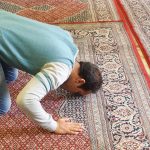
Place your forehead and nose on the ground, together with your hands, knees and toes.
Keep the body composed.
Do not rush the prostration.
While prostrating, say:
سُبْحَانَ رَبِّيَ الْأَعْلَى
Transliteration: Subḥana Rabbiyal-A‘la.
Meaning: Glory be to my Lord, the Most High.
Prostration is a position of great humility and submission to Allah.
The Prophet ﷺ said that a servant is closest to his Lord while prostrating, so Muslims should make abundant supplication in this position.
Reference: Ṣaḥīḥ Muslim, 482.
Step 10: Sit between the two prostrations
Say:
اللَّهُ أَكْبَرُ
Sit upright between the two prostrations.
Remain still rather than moving immediately into the next prostration.
A short, authentic supplication is:
رَبِّ اغْفِرْ لِي
Transliteration: Rabbighfir li.
Meaning: My Lord, forgive me.
A longer reported supplication is:
اللَّهُمَّ اغْفِرْ لِي وَارْحَمْنِي وَعَافِنِي وَاهْدِنِي وَارْزُقْنِي
Transliteration:
Allāhummaghfir lī, warḥamnī, wa ‘āfinī, wahdinī, warzuqnī.
Meaning:
O Allah, forgive me, have mercy upon me, grant me well-being, guide me and provide for me.
Reference: Sunan Abī Dāwūd, 850, and Jāmi‘ al-Tirmidhī, 284. The wording is reported in hadith literature concerning supplication between the two prostrations.
Step 11: Perform the second sujud
Say:
اللَّهُ أَكْبَرُ
Perform the second prostration in the same manner as the first.
Glorify Allah by saying:
سُبْحَانَ رَبِّيَ الْأَعْلَى
Transliteration: Subḥana Rabbiyal-A‘la.
Meaning: Glory be to my Lord, the Most High.
Maintain tranquillity.
With this prostration, the first rak‘ah is complete.
Step 12: Stand for the second rak‘ah
Say:
اللَّهُ أَكْبَرُ
Rise from prostration and stand for the second rak‘ah.
Repeat the main actions of the first rak‘ah:
Recite Surat al-Fatiḥah.
Say Amīn after completing it.
Recite another portion of the Qur’an.
Say Allahu Akbar and perform ruku‘.
Rise from ruku‘ and praise Allah.
Perform the first prostration.
Sit between the two prostrations.
Perform the second prostration.
The second rak‘ah should also be performed with composure.
Step 13: Sit after the second rak‘ah
After the second prostration of the second rak‘ah, sit for the final tashahhud.
This is the final sitting of the two obligatory rak‘ahs of Fajr.
Remain seated and recite the prescribed words of remembrance.
Step 14: Recite the final tashahhud
One authentic wording of the tashahhud is:
Arabic
التَّحِيَّاتُ لِلَّهِ وَالصَّلَوَاتُ وَالطَّيِّبَاتُ، السَّلَامُ عَلَيْكَ أَيُّهَا النَّبِيُّ وَرَحْمَةُ اللَّهِ وَبَرَكَاتُهُ، السَّلَامُ عَلَيْنَا وَعَلَى عِبَادِ اللَّهِ الصَّالِحِينَ، أَشْهَدُ أَنْ لَا إِلَٰهَ إِلَّا اللَّهُ، وَأَشْهَدُ أَنَّ مُحَمَّدًا عَبْدُهُ وَرَسُولُهُ
Transliteration
At-taḥiyyatu lillahi waṣ-ṣalawatu waṭ-ṭayyibat.
As-salamu ‘alayka ayyuhan-nabiyyu wa raḥmatullahi wa barakatuh.
As-salamu ‘alayna wa ‘ala ‘ibadillahis-salihin.
Ash-hadu an la ilaha illallah, wa ash-hadu anna Muḥammadan ‘abduhu wa rasuluh.
English meaning
All greetings, prayers and good things belong to Allah.
Peace be upon you, O Prophet, and the mercy of Allah and His blessings.
Peace be upon us and upon the righteous servants of Allah.
I bear witness that there is no deity worthy of worship except Allah, and I bear witness that Muhammad is His servant and Messenger.
Reference: Ṣahih al-Bukhari, 831; Ṣahih Muslim, 402, in the reports concerning the tashahhud.
Step 15: Send blessings upon Prophet Muhammad ﷺ
After the tashahhud, recite the Ibrahimiyyah prayer.
Arabic
اللَّهُمَّ صَلِّ عَلَى مُحَمَّدٍ وَعَلَى آلِ مُحَمَّدٍ، كَمَا صَلَّيْتَ عَلَى إِبْرَاهِيمَ وَعَلَى آلِ إِبْرَاهِيمَ، إِنَّكَ حَمِيدٌ مَجِيدٌ.
اللَّهُمَّ بَارِكْ عَلَى مُحَمَّدٍ وَعَلَى آلِ مُحَمَّدٍ، كَمَا بَارَكْتَ عَلَى إِبْرَاهِيمَ وَعَلَى آلِ إِبْرَاهِيمَ، إِنَّكَ حَمِيدٌ مَجِيدٌ.
Transliteration
Allahumma ṣalli ‘ala Muḥammadin wa ‘ala ali Muḥammad, kama ṣallayta ‘ala Ibrahima wa ‘ala ali Ibrahim, innaka ḥamidun majid.
Allahumma barik ‘ala Muḥammadin wa ‘ala ali Muḥammad, kama barakta ‘ala Ibrahima wa ‘ala ali Ibrahim, innaka ḥamidun majid.
English meaning
O Allah, send Your blessings upon Muhammad and upon the family of Muhammad, as You sent Your blessings upon Ibrahim and upon the family of Ibrahim. Indeed, You are Praiseworthy and Glorious.
O Allah, bestow Your blessings upon Muhammad and upon the family of Muhammad, as You bestowed Your blessings upon Ibrahim and upon the family of Ibrahim. Indeed, You are Praiseworthy and Glorious.
Reference: Ṣahih al-Bukhari, 3370; Ṣahih Muslim, 406.
Scholars have discussed the precise legal ruling concerning sending blessings upon the Prophet ﷺ in the final sitting. There are differences among the schools of Islamic law concerning its status as an obligatory component of prayer.
The wording above is established in authentic hadith.
Step 16: Make supplication before salam
After the tashahhud and blessings upon the Prophet ﷺ, the worshipper may make supplication before concluding the prayer.
One authentic supplication seeks protection from four matters.
Arabic
اللَّهُمَّ إِنِّي أَعُوذُ بِكَ مِنْ عَذَابِ جَهَنَّمَ، وَمِنْ عَذَابِ الْقَبْرِ، وَمِنْ فِتْنَةِ الْمَحْيَا وَالْمَمَاتِ، وَمِنْ شَرِّ فِتْنَةِ الْمَسِيحِ الدَّجَّالِ
Transliteration
Allhumma inni a‘udhu bika min ‘adhabi Jahannam, wa min ‘adhabil-qabr, wa min fitnatil-maḥya wal-mamat, wa min sharri fitnatil-Masīḥid-Dajjal.
English meaning
O Allah, I seek refuge in You from the punishment of Hell, from the punishment of the grave, from the trials of life and death, and from the evil of the trial of the False Messiah.
Reference: Ṣahih Muslim, 588.
Other authentic supplications may also be made at this stage.
Do not assume that every supplication commonly taught in a community is a required part of the prayer. Distinguish between established supplications and personal supplication.
Step 17: Conclude the prayer with salam
Turn your head to the right and say:
السَّلَامُ عَلَيْكُمْ وَرَحْمَةُ اللَّهِ
Transliteration: As-salamu ‘alaykum wa raḥmatullah.
Meaning: Peace and the mercy of Allah be upon you.
Then turn your head to the left and repeat:
السَّلَامُ عَلَيْكُمْ وَرَحْمَةُ اللَّهِ
Transliteration: As-salamu ‘alaykum wa raḥmatullah. Meaning: Peace and the mercy of Allah be upon you.
Concluding the prayer with salam is established in the Sunnah.
Reference: Ṣahih Muslim, 582, in the reports describing the Prophet’s prayer and its conclusion.
With the salam, the two obligatory rak‘ahs of Fajr are complete.
Remember: The obligatory Fajr prayer consists of two rak‘ahs, not four. The two Sunnah rak‘ahs performed beforehand are separate from the obligatory prayer.
Editorial note: Hadith numbering may differ between editions and translations. The references above use commonly cited numbering. Where a report’s authentication or application is subject to scholarly discussion, that qualification should be retained when teaching the ruling.
This article is intended as an educational introduction. For complex personal circumstances and detailed rulings where qualified scholars differ, consult a knowledgeable Sunni scholar who can explain the relevant evidence and its application.